
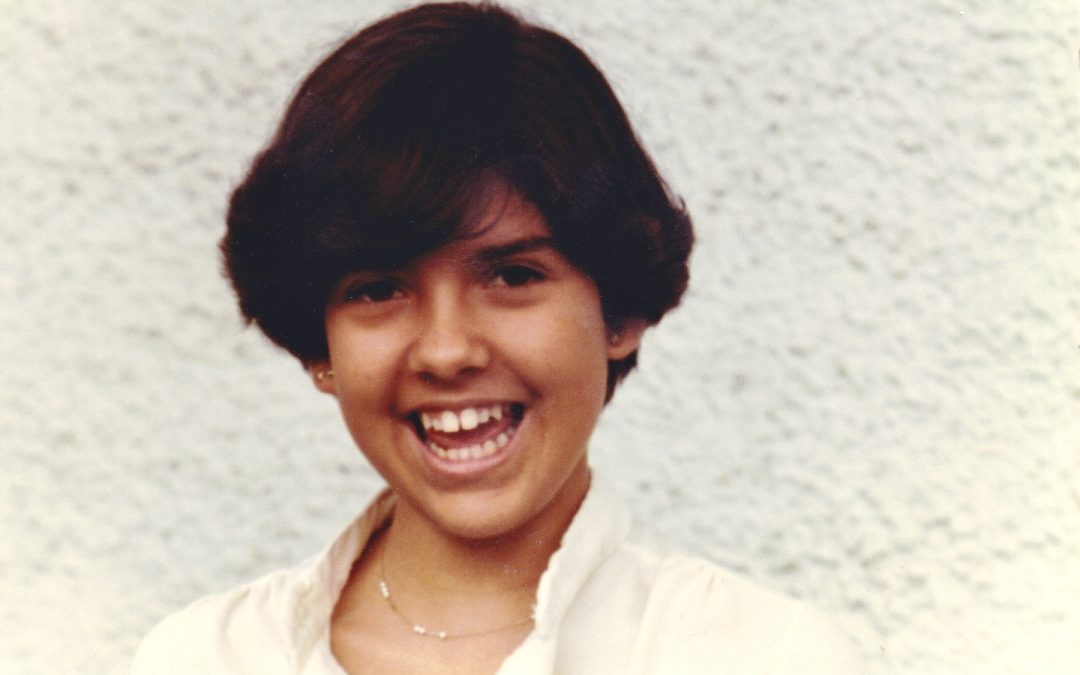
Photo of author, Marcela Gómez, Circa 1978 in Bogotá, Colombia
Every time I take a selfie with someone or a group photo, I look at myself first, I do it to make sure my eyes are open, and that I look good. When I’m with my sister, she grabs the phone from my hands and says in a judgmental voice, “You always look at yourself first!”
Doesn’t everybody?
Women, or the majority of us, were raised or programmed to put everyone else first. We are told from a young age to serve others, to think of others before ourselves. To learn how to serve, how to cook, how to…, and to look good, not for us, for them. Whoever “them” is.
In our teenage years, we’re programmed to become the woman a man would want, and this doesn’t end in high school. Recently, my dear friend Ann sent me a photo of a book she saw at her local store titled Becoming the Woman of His Dreams.
Growing up in Colombia, I remember my paternal grandmother often telling one of my aunts to serve her older brothers. Serve their meals, bring them a glass of water or coffee. I remember sitting at the table or in the living room watching this scene and not understanding why my aunts had to do these tasks when I knew that my father was perfectly capable of doing it himself. Even when the words are not uttered to program us or teach us something, we end up modeling the same behavior.
After a cookout at my brother’s home, when my sister and brother-in-law were also there, along with my nieces and nephews, we were all enjoying the conversation when I saw my sister-in-law get up to clear out the patio and the kitchen. I turned to my two nieces and told them to go help. Immediately after I said it—and after they got up to help—I thought: Why didn’t I say the same to my nephews? Why did I only tell my nieces to go help?
This is part of the programming I was raised with, and it’s one I’ve been challenging for several years. Sometimes, it still comes out of my mouth before I notice it in time to click delete and reboot.
Looking at ourselves first is not a selfish thing to do. Actually, looking at ourselves first is what we MUST do. In the Bible, Jesus instructs people to remove the “plank” from their own eye before trying to take the “speck” out of another person’s eye. Isn’t this looking at ourselves first?
I don’t remember hearing the word selfish to describe me as a child or teen, not even in college. I do, however, remember my parents referring to me as a rebel or a spoiled brat.
Even at sixty years old, my mother recently sent me an email to remind me that I have always been the most spoiled of her children because I stood up to her. As I describe this instance of me standing up to her, it sounds like I am an eight-year-old confronting her mother. But I am a sixty-year-old woman with the right to her own opinions. Still, as I read her email calling me spoiled, all I could reply was, “I don’t know what to say, so I will say nothing.”
The words selfish and rebellious still hold a lot of power, and sometimes, manipulation for me. Sometimes, I’ve felt shame and sadness for not conforming to what was expected of me, or what I thought was expected of me. And sometimes, I’ve loved those words. I’ve loved knowing that they gave me the freedom to explore life and live it my way, you know, like Frank Sinatra.
When I turned 40, a close friend and my sister planned a wonderful disco theme birthday party in Nashville. I remember every detail, the balloons, the costumes, the Saturday Night Fever and ABBA music playing throughout the evening, my son enjoying the party, my friends, and my mother and sister who had flown in from Miami were also there. It was all so much fun. But, the thing I remember the most is what my youngest sibling, my sister, said to me when she arrived from Miami for the party. I can’t recall the details of our conversation, but at some point as we were looking at childhood pictures of me, she turned to me and said, “You’re so selfish.” Oh, that has stayed with me so heavily in my heart, and it has been over 20 years already, and I still remember the way she said those words.
Several years later, I was at a fundraising event in Nashville, where I was one of the judges of a dance competition raising funds for families who are unhoused. My friend David was my plus-one. David loves taking selfies, photos of everything happening around him, and of everyone who’s with him. This is a way for him to live life to the fullest and share it with others. That evening, as usual, he took tons of photos of us.
At one point in the evening, I grabbed his phone to go through the photos, deleting the ones I didn’t like, the ones where I didn’t think I looked good. David kept telling me not to delete them, to just send myself the ones I liked but not delete the others. I didn’t pay attention to that.
I kept scrolling through the hundreds of photos he, and others, had taken of us that evening. He then turned his face towards me and said, “If only you could see yourself through my eyes.”
I froze. Everything in me felt pain. What was he saying? What did he mean? My body wanted to recoil and hide. I felt cold sweat begin to form in my arms and legs. Did I have the strength to accept his words?
We were sitting on a bench just outside the ballroom. He was in all black, wearing his Colombian hat (his sombrero vueltiao), and I was in a red sequined evening gown. I could not hold his words, I didn’t know what to do with them at the moment, so I leaned my head on his shoulder and whispered, “Thank you, thank you, thank you.”
His powerful words have stayed with me. They echo when I feel awkward, unseen, or not enough. They remind me that the flaws I think I have—inside or out—are often beliefs that don’t belong to me. They are old programming that I can choose to release.
Since then, when friends doubt their worth, when they criticize themselves or put themselves down, David’s words rise up in my soul; they become a mirror that I can hold in front of my friends.
“If only you could only see yourself through my eyes.”
Although I know that at that moment I was looking at the reflection of my outer self in photos, I took those words to be about the REAL me—my internal being, perfect—and that the flaws I think I have are beliefs that don’t belong to me, and old programming that I can change.
The word “selfish” originated in the 17th century by combining the word “self” with the suffix “-ish,” meaning “having the character of.” In the 17th century, synonyms for “selfish” included “self-seeking.”
When I turned 48 and came to the realization that there was nothing wrong with me, I became more “selfish” than before. I embraced the 17th-century synonym of the word and became more self-seeking. Are you selfish?
The Reflection and THE C.R.E.A.T.E. FRAMEWORK™
Following THE C.R.E.A.T.E. FRAMEWORK™ I created, I continue to unlearn, remember, and evolve. I invite you to practice it with the following prompts:
- Challenge Your Beliefs: Ask yourself, Why do I believe that putting myself first is wrong? Who taught me that?
- Revisit Your Stories as the Observer: Remember those moments when someone called you selfish. Revisit them not to relive them, but to release them. Like I have with my sister’s words on my 40th birthday—I know her perception of me was shaped by her own experiences, not mine. I cannot revisit her stories; I can only revisit mine with compassion.
- Engage Your Intuition: Feel into the truth that loving yourself and prioritizing your needs isn’t selfish—it’s sacred.
This process has allowed me to see that looking at myself first isn’t necessarily vanity or pride, it’s awareness. It’s connection. It’s evolution.
Marcela Gómez, is an author, speaker, and marketing & public relations expert. To learn more about Marcela click here.